Lion's mane
Hericium erinaceus
A cascade of long white spines with no cap and no gills, tasting of lobster once it hits the pan.
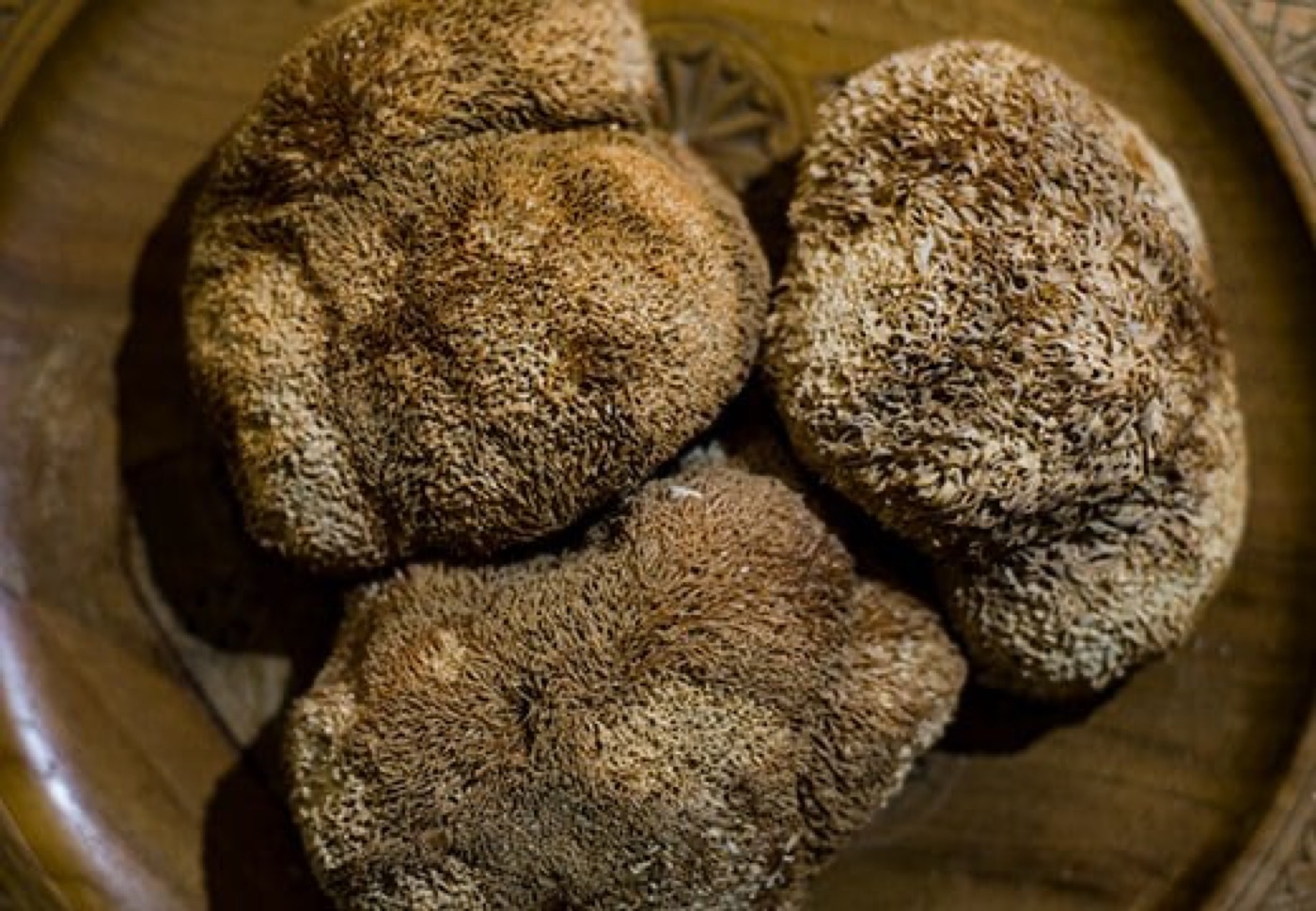
You never forget it once you have seen one: a white ball clinging to the trunk of a maple or beech, with hundreds of soft, fine spines hanging down like a beard or a frozen waterfall. No cap, no gills, no stem. In English it is also called pom-pom or bearded tooth; in Japanese, yamabushitake, the mountain-monk mushroom, for its resemblance to the fur ornament worn by the yamabushi.
In the wild and in culture
Wild lion's mane grows on the wounds of old hardwoods, often high on the trunk, in late summer and autumn. It is uncommon in the Laurentians, and Étienne prefers to leave it be. The shop's supply comes from Québec growers who raise it on logs or blocks of hardwood sawdust, where it forms handsome white balls in about ten days.
In the kitchen
First and foremost it is a remarkable table mushroom. Cut into thick slices and seared in butter, it takes on a golden crust and a fibrous texture that recalls crab or lobster. Cooks turn it into "steaks", pulled-mushroom sandwiches and broths.
In the workshop
Dried, it becomes feather-light and keeps for a long time. Étienne offers it in pieces, powdered and as a tincture. As a decoction it gives a clear, mild drink with a note reminiscent of seafood stock.
Our products are artisanal plant-based preparations. They are not intended to diagnose, treat, cure or prevent any disease.